
If you’re considering braille translation for your content, you’re already taking an important step toward accessibility.
Braille allows people who are blind or have significant vision loss to read through touch, and making your materials available in braille can dramatically expand who can access what you create.
As a Language Service Provider (LSP), we help our clients understand that braille translation isn’t just a simple copy-and-paste conversion.
So, with that in mind, if you’re considering translating content into braille, let’s walk through a few practical things you’ll want to think through before you start.
Understanding What Braille Actually Is
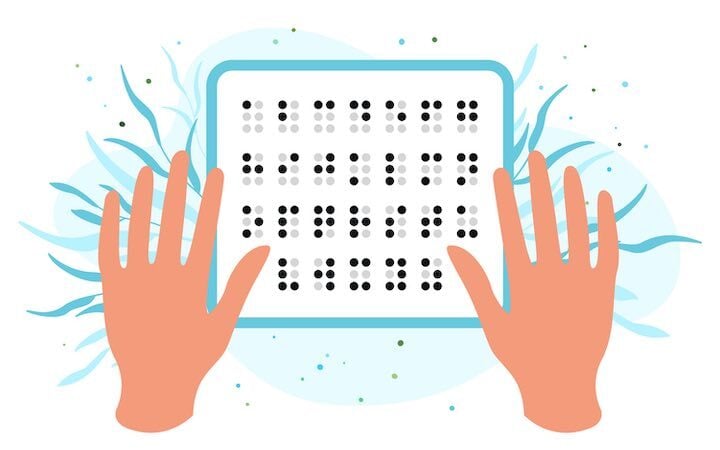
Before you dive into translation, it helps to understand that braille is its own reading system, not just a visual alphabet converted into dots. Braille uses a six-dot cell arrangement to represent letters, numbers, punctuation, and even entire words or contractions.
In English, most braille readers use what’s called contracted braille. This system shortens common words and letter combinations into single symbols or patterns.
The goal is to make reading faster and reduce the amount of space braille takes on a page. Because of this, a direct letter-by-letter conversion isn’t usually the best approach.
When you plan a braille translation, you’ll want to confirm which braille code should be used. In the United States, Unified English Braille (UEB) is the standard.
Thinking About Your Audience
One of the first questions to ask yourself is who will actually read the braille version of your material. Different audiences sometimes require slightly different formatting approaches.
For example, educational materials may need very strict formatting rules so that they work well in classroom settings. Meanwhile, a restaurant menu, brochure, or informational pamphlet might prioritize simplicity and quick navigation.
If your readers include braille learners, you might even choose uncontracted braille, which spells everything out letter by letter. This is less common for general reading but helpful for beginners.
The clearer you are about your audience, the easier it will be to produce a braille version that truly works for them.
Planning for Layout Differences
One thing that often surprises people is how much longer braille documents can be compared to print.
Braille characters take up more physical space than printed text. A typical braille page holds far fewer words than a standard printed page. That means your 10-page document might expand to 25 or even 30 braille pages.
Because of this, layout needs to be reconsidered. Headings, spacing, and page breaks often have to be redesigned so that the document remains easy to navigate by touch.
If your document contains tables, sidebars, or multi-column layouts, these will likely need to be simplified or restructured during translation.
Handling Images, Charts, and Graphics
Visual elements are another area you’ll want to think about early in the process. Photos, charts, graphs, and diagrams obviously don’t translate directly into braille.
There are a few possible solutions. Sometimes the best option is to write clear, descriptive text that explains what the image conveys. In other cases, tactile graphics can be created so readers can feel shapes, lines, and structures with their fingers.
Tactile graphics require specialized production, so they can add time and cost to a project. Still, they’re incredibly valuable when the visual information is essential to understanding the content.
Preparing Your Source Files
The format of your original document matters more than you might think. Clean, well-structured source files make braille translation much smoother.
If you’re starting with a digital document, it helps if it already uses proper headings, consistent styles, and logical reading order. Documents filled with manual formatting, random spacing, or embedded text in images can create extra work during translation.
The goal is to give the braille translator something organized and predictable to work from. A well-prepared file can save hours of editing later.
Choosing the Right Translation Method
Braille translation usually involves a combination of software and human review. Automated translation tools can convert text into braille quickly, but they’re rarely perfect on their own.
A trained braille transcriber typically reviews the output to ensure contractions, formatting, and special symbols are used correctly.
This step is especially important for technical material, educational content, or anything with math or specialized notation.
If accuracy matters, and it almost always does, you’ll want that human expertise involved.
Considering Production and Embossing
Once your document is translated into braille, it still needs to be produced in a physical format. Braille is typically printed using an embosser, which presses raised dots into thick paper.
This stage introduces a few more considerations. Paper size, binding method, and durability all affect how usable the final document will be.
Large braille documents may need to be split into multiple volumes so they’re easier to handle.
If your goal is distribution, you’ll also want to think about storage and shipping, since braille materials can be bulkier than their print counterparts.
Budgeting Time and Cost
Braille translation and production involve specialized skills and equipment, so it’s important to plan for both time and cost.
Short documents can sometimes be turned around quickly, but larger projects, especially those with complex formatting or tactile graphics, may take longer. Factoring braille into your accessibility planning early helps prevent last-minute stress.
The good news is that once a document has been properly translated and formatted, it’s much easier to update and reproduce in the future.
Keeping Accessibility at the Center
Ultimately, braille translation is about making sure people who rely on braille have equal access to information. When done thoughtfully, it allows readers to engage with your content independently and confidently.
As you move forward, try to think about accessibility from the very beginning of your content creation process. When documents are designed with accessibility in mind from the start, braille translation becomes far smoother and more effective.
Do you have braille translation requirements? If so, we’d love to talk to you. Consultations are free and there’s no obligation.
You’re in safe hands with us as we’re ISO 17100 and ISO 9001 compliant, have over twenty years of professional translation experience, and have earned the trust of organizations around the world.