
When you translate content for your business, accuracy is obviously important. You need the translated words to communicate the same information as the original. But accuracy is only part of the story.
We’re a Language Service Provider (LSP), and we’re frequently explaining to clients that a translation can be technically correct and still feel awkward, complicated, or difficult to read.
And if your audience has to work too hard to understand what you’re saying, there’s a good chance they’ll simply stop reading.
That’s why high-quality translation needs to focus on readability just as much as accuracy.
What Do We Mean By Readability?
Readability is simply how easy your content is to read and understand. In your own language, you probably notice poor readability immediately.
Sentences feel too long. Words seem unnecessarily complicated. Ideas don’t flow naturally from one paragraph to the next. The same thing can happen during translation.
Good translators aren’t simply replacing words. As we explain when looking at what makes a good translator, they’re also writers. Their job is to understand what you want to say and express it naturally in another language.
Ideally, your reader shouldn’t even be thinking about the fact that the content has been translated.
Accurate Doesn’t Always Mean Easy To Read
This is where translation can get tricky. Imagine you have a sentence in English containing an idiom, a long explanation, or a piece of industry jargon.
Translating every word accurately may produce something grammatically correct, but that doesn’t necessarily mean someone would naturally say it that way.
A word-for-word approach can make content feel stiff or confusing, which is one of the common pitfalls of website translation. The better approach is to preserve the meaning while giving the translator enough freedom to make the sentence work naturally in the target language.
After all, your reader doesn’t care whether every individual word matches the original. They care whether they understand you.
Readability Helps You Connect With Customers
There’s a practical business reason to care about all of this. CSA Research surveyed 8,709 consumers across 29 countries and found that 76% of people prefer to buy products with information in their own language.
More strikingly, 40% said they would never buy from websites in another language.
But providing content in someone’s language is only the first step. It also needs to feel comfortable and familiar. That’s why a good website localization strategy considers tone, terminology, cultural expectations, and the way your audience naturally communicates.
When your translated content is easy to read, you remove friction between your business and your customer.
Your Brand Voice Still Matters
You’ve probably spent years developing the way your business communicates. Maybe your tone is friendly and informal. Perhaps it’s reassuring and authoritative. Whatever it is, you don’t want that personality disappearing when your content crosses a border.
Readability plays a big role in maintaining that voice. A useful starting point is creating style guides and glossaries for localization. These give translators guidance about your preferred terminology, sentence style, tone, and brand language.
This becomes particularly important when you’re translating large volumes of content or working across several languages. Your customers should feel like they’re hearing from the same company wherever they are.
Readability Is About Culture Too
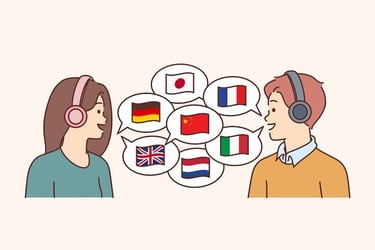
People don’t communicate in exactly the same way everywhere. Humor, idioms, sentence structure, levels of formality, and even the amount of information people expect can change between cultures.
Something that feels friendly and conversational to an American audience might sound overly casual somewhere else.
That’s where cultural sensitivity in translation becomes important. A readable translation takes these differences into account. Instead of forcing the structure of the source language onto your audience, we adapt the content so it feels appropriate to the people actually reading it.
The message stays the same, but the way it’s delivered may change.
Technology Still Needs A Readability Check
AI and machine translation have become incredibly useful, especially when businesses need to translate large volumes of content quickly.
The language services market itself continues to grow alongside these technologies. Nimdzi Insights estimated the industry reached $71.7 billion in 2024 and projected it to reach $75.7 billion in 2025.
But speed doesn’t automatically produce readable content. AI can generate a technically impressive translation while still missing tone, cultural context, idioms, or brand personality. These remain some of the areas where AI translation can still get things wrong.
For customer-facing or high-value content, human review can make the difference between something that merely makes sense and something people actually enjoy reading.
Readability Should Be Part Of Quality Control
When we review a translation, we’re not only asking, “Is this correct?”
We’re also asking whether it flows naturally, whether the terminology makes sense, whether the tone fits your audience, and whether anything sounds like a translation rather than original content.
A structured translation, editing, and proofreading process gives different linguists the opportunity to look at the content from slightly different perspectives. That extra review can catch sentences that are accurate but still don’t sound quite right.
Ultimately, readability is about respecting your reader’s time. You want your international customers to understand your message without stopping to decipher it. When your translation feels clear, natural, and familiar, your audience can focus on what you’re actually trying to tell them.
And that’s when translation stops feeling like translation and simply becomes good communication.
Are you looking to partner with a LSP to help you with translation requirements? If so, get in touch.
Consultations are free and there’s no obligation. You’re in safe hands with us as we’re ISO 17100 and ISO 9001 compliant, have over twenty years of professional translation experience, and have earned the trust of organizations around the world.